
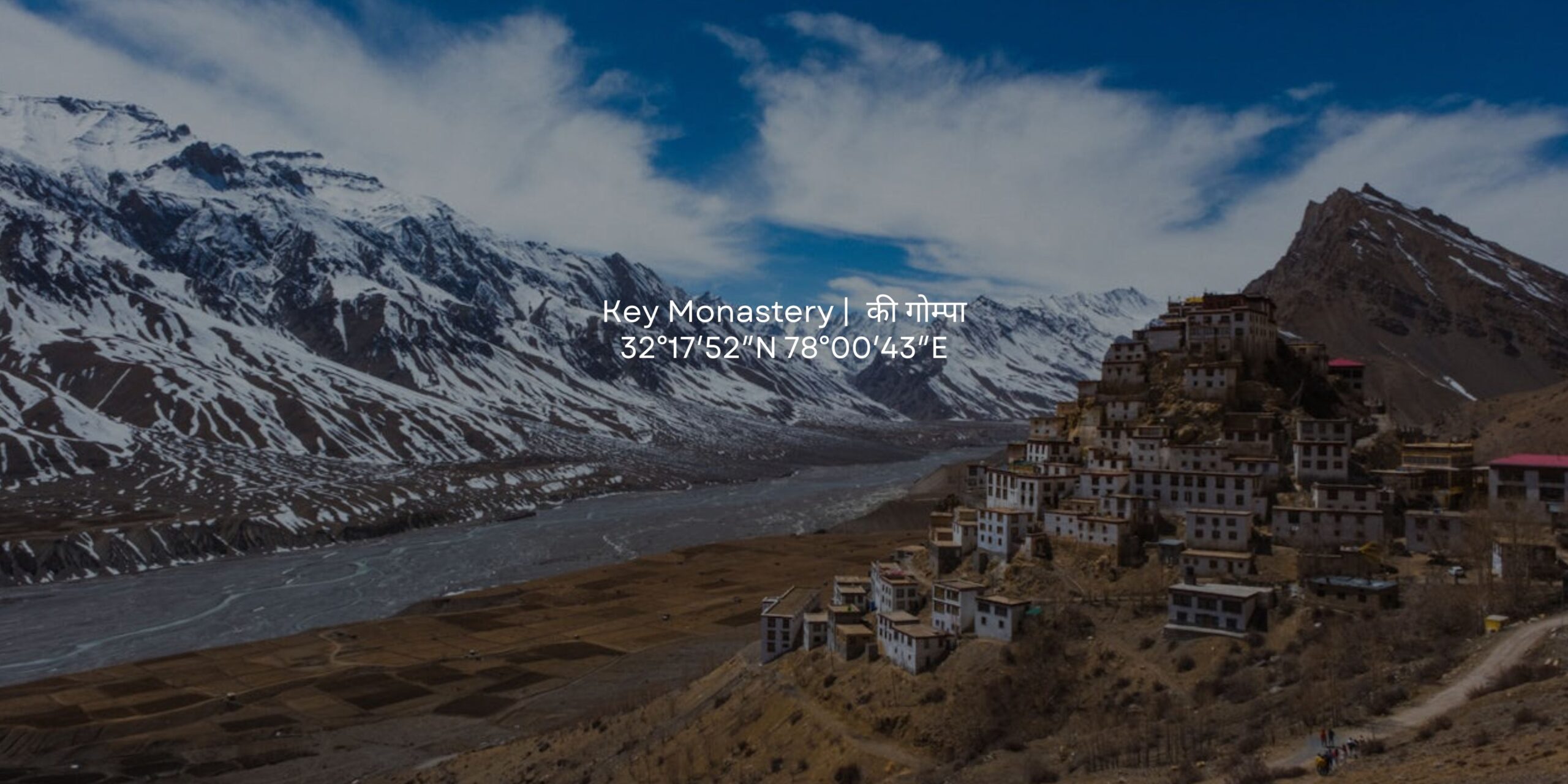
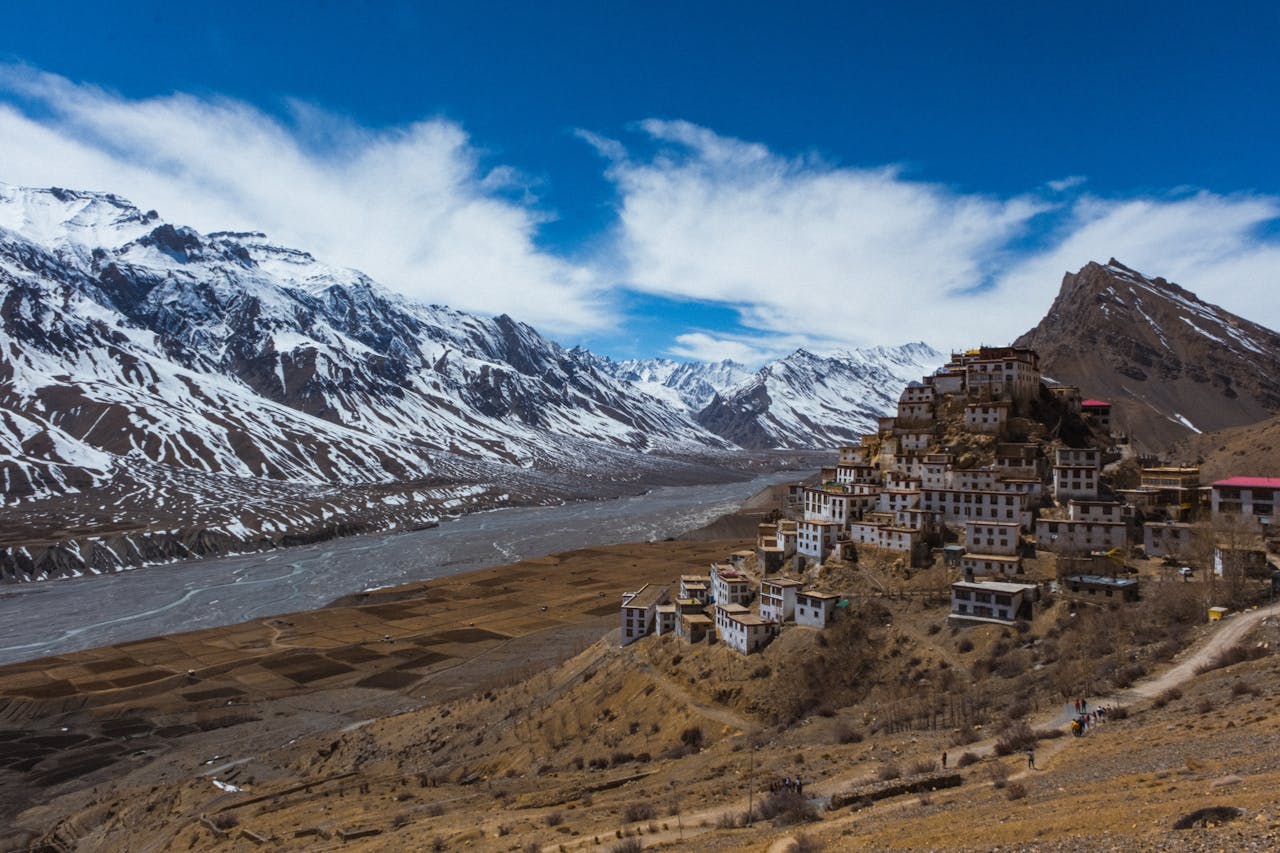
Key Monastery Destination Image with Coordinates 2026 HD

Key Monastery, Spiti Valley: History, Height, Timings & Travel Guide

Rising dramatically above the Spiti River at an altitude of over 4,100 meters, Key Monastery is the largest and most influential monastery in the region. Often referred to as Ki or Kye Gompa, this historic Key Monastery in Spiti Valley has served as a major center of Tibetan Buddhist learning for centuries. Its strategic hilltop location, overlooking vast stretches of the valley, reflects both its spiritual significance and its historical need for protection.

What makes Key Monastery Spiti especially fascinating is that it is not a single-period structure. Over the years, the monastery has been attacked, damaged by earthquakes, and rebuilt multiple times. Instead of being reconstructed in a uniform style, newer sections were added over older ones, giving the monastery its distinctive layered, fortress-like architecture. Today, it houses more than 250 monks, many of whom receive formal monastic education here from a young age.

Inside, Key Monastery reveals a world of ancient murals, sacred thangkas, rare Buddhist scriptures, and prayer halls that echo with daily chants and philosophical debates. Far from being a silent relic, Key Monastery in Spiti Valley remains a living institution—one that continues to shape the spiritual, cultural, and educational life of Spiti. For travelers, visiting Key Monastery is not just about seeing a famous landmark; it is about understanding the very heart of Spiti Valley.

History of Key Monastery: The Story Behind Spiti Valley’s Most Iconic Gompa

The history of Key Monastery is deeply intertwined with the history of Spiti Valley itself. Believed to have been founded around the 11th century, Key Monastery has stood as a center of Buddhist learning for nearly 1,000 years, making it one of the oldest and most historically significant monasteries in the region. Over centuries, this Key Monastery in Spiti Valley has witnessed invasions, political shifts, natural disasters, and cultural change—yet it continues to thrive.

Early records suggest that Key Monastery rose to prominence as part of the Gelugpa (Yellow Hat) sect of Tibetan Buddhism, the same order to which the Dalai Lama belongs. Its strategic hilltop location was not chosen randomly. During medieval times, Spiti lay on important trade and cultural routes between India and Tibet, making monasteries like Key vulnerable to attacks. Historical accounts indicate that Key Monastery was raided multiple times, particularly during conflicts involving Mongol invasions and regional power struggles.

Instead of being rebuilt from scratch after each destruction, the monastery evolved organically. This is why the architecture of Key Monastery Spiti looks layered and irregular—new sections were added atop damaged ones, creating a structure that resembles a fortress as much as a monastery. This unique architectural growth is a direct result of its turbulent past and is one of the most fascinating physical reflections of the monastery’s history.

Key Monastery in Spiti History

Natural forces were just as challenging. Earthquakes and harsh Himalayan winters repeatedly damaged parts of the monastery. In the mid-20th century, Key Monastery suffered significant destruction due to seismic activity, after which restoration efforts were undertaken with support from both the monastic community and the Archaeological Survey. Despite these challenges, the monastery never lost its role as an educational hub.

Today, the legacy of the history of Key Monastery lives on through its monks. The monastery functions as a training center for young monks, many of whom come from villages across Spiti and nearby regions. They study Buddhist philosophy, scriptures, logic, and debate—continuing traditions that have existed here for centuries. Walking through its corridors, you are not just observing history; you are standing inside a living institution shaped by resilience, faith, and time.

For travelers, understanding the history of Key Monastery in Spiti Valley transforms the visit. What may first appear as a dramatic hilltop structure becomes a symbol of survival—one that has endured for nearly a millennium in one of the harshest inhabited landscapes on Earth.
Why Key Monastery Is Famous in Spiti Valley

Key Monastery is famous in Spiti Valley because it represents everything the region stands for—spiritual depth, resilience, and life at extreme altitude. As the largest monastery in Spiti Valley, it has historically functioned as the primary center of Buddhist learning and continues to shape the spiritual life of the region today.

Several factors make Key Monastery in Spiti Valley stand out:

  • Largest and most influential monastery in Spiti
    Key Monastery serves as a major monastic education center, housing over 250 monks who study Buddhist philosophy, scriptures, and debate. Monks from surrounding villages often train here, reinforcing its role as the valley’s spiritual backbone.

  • Dramatic hilltop location
    Perched at an altitude of over 4,100 meters, Key Monastery overlooks the Spiti River and vast mountain landscapes. Its fortress-like position makes it one of the most recognizable and photographed landmarks in Spiti Valley.

  • A living, active monastery
    Unlike many historical monasteries, Key is not preserved solely for tourism. Daily prayer sessions, teaching schedules, and monk debates continue uninterrupted, allowing visitors to witness authentic monastic life in action.

  • Architectural uniqueness shaped by history
    Due to repeated invasions and earthquakes, the monastery was rebuilt multiple times. Instead of uniform reconstruction, newer sections were layered over older ones, giving Key Monastery Spiti its distinctive stacked and maze-like structure.

  • Cultural and religious importance
    Key Monastery plays a central role during religious festivals, teachings, and seasonal rituals. It often hosts important ceremonies that attract monks and villagers from across Spiti Valley.

  • Preserved art and heritage
    Inside the monastery are ancient murals, thangkas, manuscripts, ritual instruments, and statues that have survived for centuries—making it both a spiritual center and a living archive of Tibetan Buddhist art.

Together, these elements explain why Key Monastery in Spiti Valley is considered more than just a tourist attraction. It is a place where history, faith, education, and everyday life continue to exist side by side.

Also checkout: Tabo Monastery in Spiti Valley

Key Monastery Height & Location

Understanding the height and location of Key Monastery helps explain why this sacred site feels so powerful the moment you arrive. Set in one of the most remote corners of Himachal Pradesh, Key Monastery in Spiti Valley stands high above the surrounding villages, overlooking the vast Spiti River basin and barren Himalayan terrain.

Key Monastery Height

  • Key Monastery height: approximately 4,166 meters (13,668 feet) above sea level

  • This extreme altitude makes it one of the highest monasteries in Spiti Valley

  • Due to the thin air, visitors may experience shortness of breath, especially during the first few hours

The high Key Monastery height is not just geographical—it also adds to the spiritual atmosphere. At this elevation, silence feels deeper, and the surrounding landscape naturally encourages reflection and calm. For travelers, this altitude also means proper acclimatization is important, especially if you’re arriving from lower regions like Manali or Shimla.

Key Monastery Location

  • Located in Lahaul and Spiti district, Himachal Pradesh

  • Situated near Kibber village in central Spiti Valley

  • Approximately 12 km from Kaza, the main town and travel base in Spiti

  • Positioned on a hilltop overlooking the Spiti River

The location of Key Monastery in Spiti Valley is strategic and symbolic. Historically, its elevated position offered protection from invasions while allowing monks to remain spiritually isolated from daily village life. Even today, the monastery’s location gives visitors panoramic views of the valley, making it one of the most scenic monastery sites in the region.

Because of its proximity to Kaza, Key Monastery Spiti is easily accessible compared to many other monasteries in Lahaul Spiti. Most travelers visit it as part of a Kaza–Kibber–Key circuit, often combining it with nearby high-altitude villages like Langza and Komic.

Why the Height & Location Matter for Visitors

  • High altitude means cool temperatures even in summer

  • Stunning sunrise and sunset views over Spiti Valley

  • Thin air requires slow movement and hydration

  • The hilltop setting enhances both photography and spiritual experience

The unique height and location of Key Monastery in Spiti Valley are central to its identity. They don’t just define where the monastery stands—they shape how it feels, how it functions, and why it remains one of the most unforgettable places to visit in Spiti.

Also checkout: Dhankar Monastery in Spiti Valley

Key Monastery Inside: What You’ll See, Feel, and Understand

Stepping key monastery inside is where the visit transforms from sightseeing into understanding. Beyond the dramatic exterior, the interiors reveal how this centuries-old institution functions as a living center of learning, ritual, and discipline—unchanged in spirit despite the passing of time.

As you move through the monastery’s inner spaces, you’ll notice a deliberate simplicity. The layout is layered and compact, shaped by generations of rebuilding after invasions and earthquakes. Narrow staircases, low doorways, and interconnected rooms reflect an architecture designed for protection, focus, and communal living rather than grandeur.

Here’s what you’ll encounter when exploring key monastery inside in detail:

key monastery inside latest 2026 image HD

Prayer halls steeped in symbolism

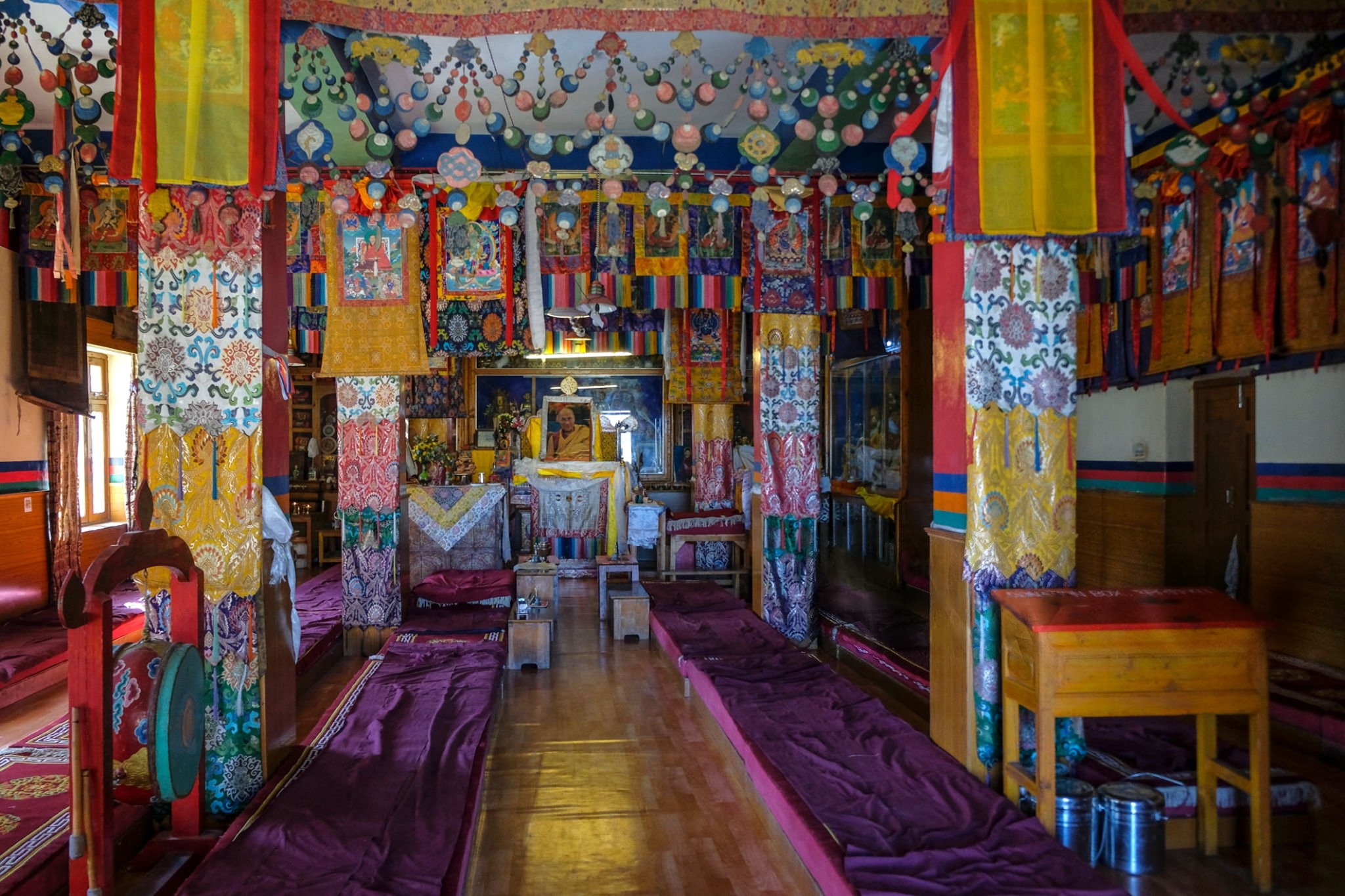
The main prayer halls house large statues of Buddha, protector deities, and revered teachers of the Gelugpa order. Walls are covered with ancient murals and mandala paintings, many faded with age but rich in meaning. These artworks were created as visual guides to Buddhist philosophy, helping monks internalize teachings through imagery.

Sacred manuscripts and learning spaces

Wooden shelves hold handwritten and printed Buddhist scriptures, some preserved for centuries. These texts are still actively used for study and chanting, reinforcing that this is not a museum but an active place of education.

Monk living quarters and study rooms

Small rooms tucked into different levels serve as sleeping and study spaces for monks. The modest conditions reflect the principles of discipline and detachment that define monastic life in Spiti Valley.

Also Read: Can you stay in Key Monastery?

Open courtyards for philosophical debates

One of the most striking experiences inside the monastery complex is watching monks engage in traditional debate sessions. These energetic discussions—marked by claps and gestures—are a core teaching method in Tibetan Buddhism and often leave visitors fascinated.

A soundscape of devotion

Soft chanting, the hum of prayer wheels, and the occasional ring of ritual instruments fill the air. Even during busy hours, the inner sections maintain a calm, contemplative rhythm.

Photography is usually permitted in outer areas, but inside prayer halls it may be restricted—always seek permission.

Ultimately, spending time key monastery inside helps visitors grasp why this place holds such importance in Spiti Valley. The interiors reveal a world where spirituality, education, and daily routine are seamlessly intertwined. For many travelers, it is this intimate glimpse into monastic life—rather than the views outside—that leaves the deepest and most lasting impression.

Explore More Monasteries in Spiti Valley.

Key Monastery Timings & Entry Fee

Knowing the Key Monastery timings and entry details helps you plan your visit better—especially in a region like Spiti Valley, where weather, daylight, and road conditions can influence everything. Since Key Monastery in Spiti Valley is an active religious institution, visiting hours are designed around daily prayer schedules rather than tourism alone.

Key Monastery Timings

  • Open daily: 6:00 AM to 6:00 PM

  • Morning hours (6:00–9:00 AM) often coincide with prayer sessions, offering a quieter and more spiritual atmosphere

  • Late afternoons provide softer light and fewer crowds, ideal for photography and relaxed exploration

These Key Monastery timings may vary slightly during festivals or extreme weather, but the monastery generally remains accessible throughout the main travel season.

Entry Fee at Key Monastery

  • Entry fee: Free

  • There is no ticket required to visit Key Monastery

  • Visitors are encouraged to make a voluntary donation, which helps support:

    • Daily operations of the monastery

    • Education and living expenses of monks

    • Maintenance of ancient murals and structures

Occasionally, there may be a small photography fee for specific interior areas, depending on monastery rules at the time of your visit.

Best Time of Day to Visit

  • Early morning: Peaceful, spiritual, fewer visitors

  • Late afternoon: Better lighting, relaxed pace, panoramic valley views

  • Midday: Can be busier due to tour groups, especially in peak season

Things to Keep in Mind

  • Dress modestly and respectfully

  • Maintain silence inside prayer halls

  • Follow instructions from monks or caretakers

  • Avoid interrupting prayer sessions

Understanding the Key Monastery timings and entry fee ensures that your visit is not only smooth but also respectful of the monastery’s spiritual rhythm. Planning around these details allows you to experience Key Monastery in Spiti Valley at its most authentic.

How to Reach Key Monastery

Reaching Key Monastery in Spiti Valley is straightforward once you arrive in Kaza, the main base town of the region. The monastery’s location near popular villages makes it one of the easiest gompas to access in Lahaul Spiti.

  • From Kaza:
    Key Monastery is about 12 km from Kaza. You can hire a local taxi or drive via the Kibber road, which is motorable during the summer season.

  • From Manali or Shimla:
    Travel to Kaza first, then continue onward to Key Monastery. Roads are open roughly from May to October, depending on weather conditions.

  • Local travel tips:
    Roads are narrow and at high altitude, so drive slowly. Allow time for acclimatization, and avoid rushing if you’re visiting on the same day you arrive in Kaza.

Best Time to Visit Key Monastery

The best time to visit Key Monastery is during the summer and early autumn months, when Spiti Valley is accessible and weather conditions are relatively stable. Since Key Monastery in Spiti Valley is located at a high altitude, seasonal timing plays a major role in road access and overall comfort.

  • Best months: May to October

  • Most ideal period: June to September (clear skies, comfortable daytime temperatures)

  • Winter (November to April): Extremely cold, with roads often closed due to heavy snowfall

During the recommended season, the monastery is fully active, and visitors can witness daily prayers, monk debates, and routine monastic life. Early mornings and late afternoons are especially peaceful and offer beautiful views of the surrounding valley.

Visiting during the best time to visit Key Monastery ensures a smoother journey and a more meaningful experience, while detailed seasonal planning can be explored in a dedicated guide later.

Tips for Visiting Key Monastery

Visiting Key Monastery is a rewarding experience, but a little preparation goes a long way—especially given its altitude and spiritual importance. These simple tips will help you make the most of your visit while being respectful and comfortable.

  • Acclimatize properly
    Key Monastery is located above 4,100 meters. Spend at least a day in Kaza before visiting to avoid altitude sickness.

  • Dress modestly and warmly
    Even in summer, temperatures can drop quickly. Wear layers and avoid sleeveless or revealing clothing inside prayer areas.

  • Maintain silence inside prayer halls
    This is an active monastery, not just a tourist site. Keep your voice low and avoid interrupting prayers or teachings.

  • Ask before taking photos
    Photography may be restricted inside certain areas. Always seek permission, especially inside prayer halls.

  • Visit during quieter hours
    Early mornings and late afternoons are more peaceful and allow a deeper connection with the place.

  • Respect monastic life
    Avoid touching religious objects, don’t disturb monks during study or debate sessions, and follow local guidance.

  • Carry water and move slowly
    The high altitude can be dehydrating. Walk at a relaxed pace and stay hydrated.

Following these tips ensures that your visit to Key Monastery in Spiti Valley is not only enjoyable but also respectful of the traditions and people who have preserved this sacred place for centuries.